
Meta Tags Generator
Generate SEO-friendly meta tags including Open Graph, Twitter Card, and canonical tags — copy-ready HTML with live preview.
This hub collects the best free browser-based meta tag generation and validation tools in — covering title tags, meta descriptions, Open Graph properties, Twitter Cards, canonical tags, robots directives, and hreflang tags — all zero signup, instant copy-paste output.
Updated · Reviewed by The Free AI Tools Editorial Team — Meta tags and SERP optimization tools review
Generate SEO-friendly meta tags including Open Graph, Twitter Card, and canonical tags — copy-ready HTML with live preview.
Preview title tags, URLs, and meta descriptions in a Google-style search result layout — SEO snippet tool.
Review meta descriptions for character length and snippet-friendly ranges — bulk SEO meta audit tool.

Preview how Open Graph titles, descriptions, and images appear when shared on social media — OG tag tester.
Validate Twitter Card meta tags and preview card-style output — test X/Twitter link sharing appearance.

Create canonical link tags for pages, product variants, and paginated URLs — prevent duplicate content issues.

Generate hreflang link tags for multilingual and multi-region sites — correct international SEO targeting.

Create robots.txt files for your website — control search engine crawlers, disallow paths, and set sitemaps.

Turn page titles into clean, readable, SEO-friendly URL slugs — remove stop words and special characters.

Inspect pasted HTML for title, description, canonical, and social tags — audit any page's SEO meta structure.

Generate valid JSON-LD for articles, organizations, products, FAQs, and local businesses with instant preview and rule checks. It helps SEO teams ship structured data faster without copy-pasting uncertain snippets.

Generate XML sitemaps from a list of URLs — set priorities, change frequencies, and download instantly.
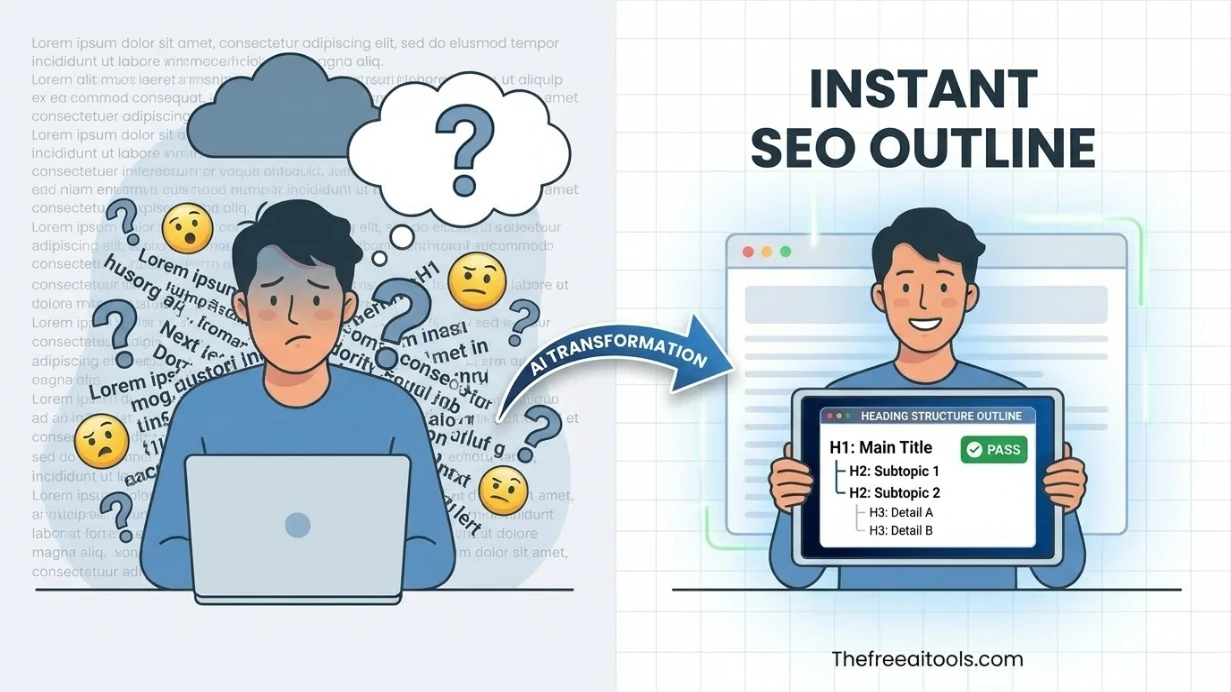
Audit pasted HTML for heading order, skipped levels, and document outline clarity — accessibility and SEO check.
Review image alt text for length, clarity, duplication, and decorative-image handling. It helps content teams write accessible image descriptions without relying on AI or third-party APIs.
Analyze repeated phrases and top keywords inside any text block — optimize content for search rankings.
Estimate Flesch-Kincaid readability and sentence complexity from text — optimize content grade level instantly.
Visualize redirect chains from pasted crawl exports, response logs, or manually entered hops so teams can trim unnecessary redirects. This is useful during migrations, replatforms, and large-scale URL cleanup projects.

Create consistent UTM URLs, validate naming conventions, and catch messy campaign tagging before links go live. It helps marketing teams keep analytics cleaner across channels and stakeholders.

Extract a color palette from pasted CSS or HTML color values — build brand color systems instantly.

Count words, characters, sentences, and estimate reading time — with keyword density analysis.

Paraphrase and rewrite text using AI to sound natural, improve clarity, and bypass AI content detectors.

Turn simple ideas into highly detailed, optimized prompts for Midjourney, ChatGPT, Stable Diffusion, Claude, and DALL-E using AI.
Meta tags are the most searched and most misunderstood technical SEO topic on the internet. Billions of pages are published every year with missing, duplicate, or incorrectly formatted meta tags — and every one of those pages is leaving ranking performance on the table. The free tools in this hub cover every meta tag type that matters in 2026: the title tag and meta description that control SERP display, the Open Graph and Twitter Card tags that control social sharing appearance, the canonical tag that consolidates ranking signals, the robots meta directive that controls indexation, and the hreflang tag that serves international audiences correctly.
Title tag optimization is the highest-ROI single action in SEO. A title tag that contains the primary keyword near the front, accurately describes the page content, and stays within Google's display limit of approximately 60 characters drives more organic clicks than a title that is too long, too generic, or missing the target keyword. The SERP snippet preview on this hub renders your title in Google's actual display format — showing exactly where truncation occurs — so you can perfect the display before the page is ever indexed.
Open Graph configuration is the meta tag category most frequently misconfigured on professional websites in 2026. When a URL without correct og:image, og:title, and og:description tags is shared on Facebook, LinkedIn, or Pinterest, the social platform displays a generic or blank preview that earns dramatically fewer clicks than a correctly configured card. The open graph preview tool on this hub shows exactly what each social platform will display for any URL, so teams can fix broken previews before content is distributed.
Canonical tag errors are among the most damaging and hardest-to-detect technical SEO problems on established sites. A canonical tag that points to a non-existent URL, points to a redirected URL, or creates a canonical loop actively tells Google to ignore the very page you want to rank. The canonical tag generator produces correctly formatted canonical tags, and the SEO meta extractor validates the canonical currently in place on any live URL — together they close the most common canonical mistake loop in site management.
Quick answers about the workflow, privacy, and where this tool fits in a broader job.
Every page needs five essential meta tags: a title tag (50-60 characters), a meta description (150-160 characters), a canonical tag pointing to the preferred URL, a robots meta directive, and Open Graph tags for social sharing. Use the meta tag generator on this hub to produce all five in one workflow.
Google typically displays 150-160 characters of a meta description in desktop search results and approximately 120 characters on mobile. The meta description length checker on this hub shows exactly where your description gets truncated so you can adjust before publishing.
Standard meta tags (title, description, canonical) communicate with search engine crawlers. Open Graph tags (og:title, og:description, og:image, og:url) communicate with social platform crawlers — Facebook, LinkedIn, Pinterest, Slack — to control how your content appears when shared. Both sets are required for complete metadata.
Yes. The SEO meta extractor on this hub fetches the complete metadata profile from any publicly accessible URL — title tag, meta description, canonical, robots directives, Open Graph properties, and Twitter Card data — in seconds.
No. Google, Bing, and all major search engines have ignored the meta keywords tag since approximately 2009. Focus entirely on title tags, meta descriptions, canonical tags, and structured data — these are the metadata elements that actually affect rankings and click-through rates.
The complete toolkit
Every tool runs instantly in your browser — no account, no download, no cost. Across 13 categories for everyday tasks.