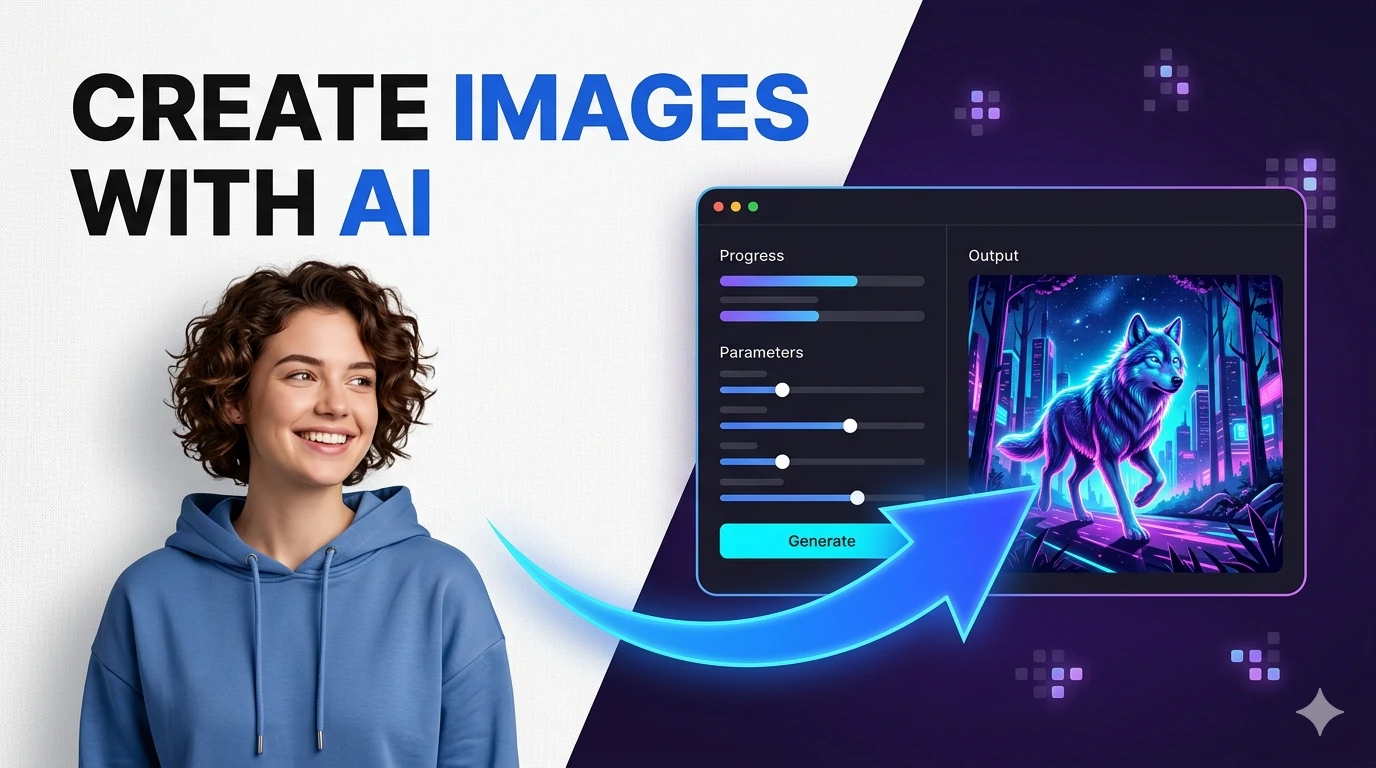
A UX designer needed 40 unique concept images for a client presentation on a smart home product line. Stock photo budget: zero. Timeline: one afternoon. She generated all 40 using an AI image generator with structured prompts (style + subject + lighting + mood for each image set). Client approved 34 of the 40 on first review. The 6 rejected were all close-up shots involving hands — which AI image models still render unreliably.
That failure case reveals something important about how diffusion models work. They learn to reconstruct images by starting from random noise and iteratively denoising guided by a text embedding. They do not understand 3D anatomy — they learn statistical patterns. Hands appear in an enormous variety of poses in training data, producing high-variance outputs. Faces trained on billions of human portraits converge to a tighter distribution.
Prompt Structure That Produces Consistent Results
| Prompt component | Position | Example |
|---|---|---|
| Subject | First (highest weight) | "A Moroccan riad interior" |
| Style | Second | "watercolor illustration" |
| Lighting | Third | "golden hour sunlight through zellige tiles" |
| Camera / perspective | Fourth | "wide angle, low perspective" |
| Quality modifiers | Last | "highly detailed, 4K, sharp focus" |
What AI Image Generators Cannot Do
- Render legible text: Text in generated images is almost always garbled. If your image needs readable words, add them in post-processing (Canva, Figma, Photoshop).
- Maintain character consistency across images: Generate image A and image B with "the same woman" in the prompt — you will get two different people. Consistent character identity requires reference image conditioning (img2img or LoRA fine-tuning), not available in basic generators.
- Accurate logos and brand elements: Logos are vector graphics with specific geometry. Diffusion models treat them as textures and distort them.
- Complex spatial reasoning:"A cat sitting on a chair that is next to a table with a vase on it" — the spatial relationships frequently break. One element will dominate and the others will be in wrong positions.
Copyright Status of AI-Generated Images
In the US, purely AI-generated images without human creative selection and arrangement are not eligible for copyright protection (US Copyright Office, February 2023 guidance). This means anyone can use, copy, and redistribute the generated image. If you need exclusive rights, you need a human author's creative selection to be a substantial part of the final work.