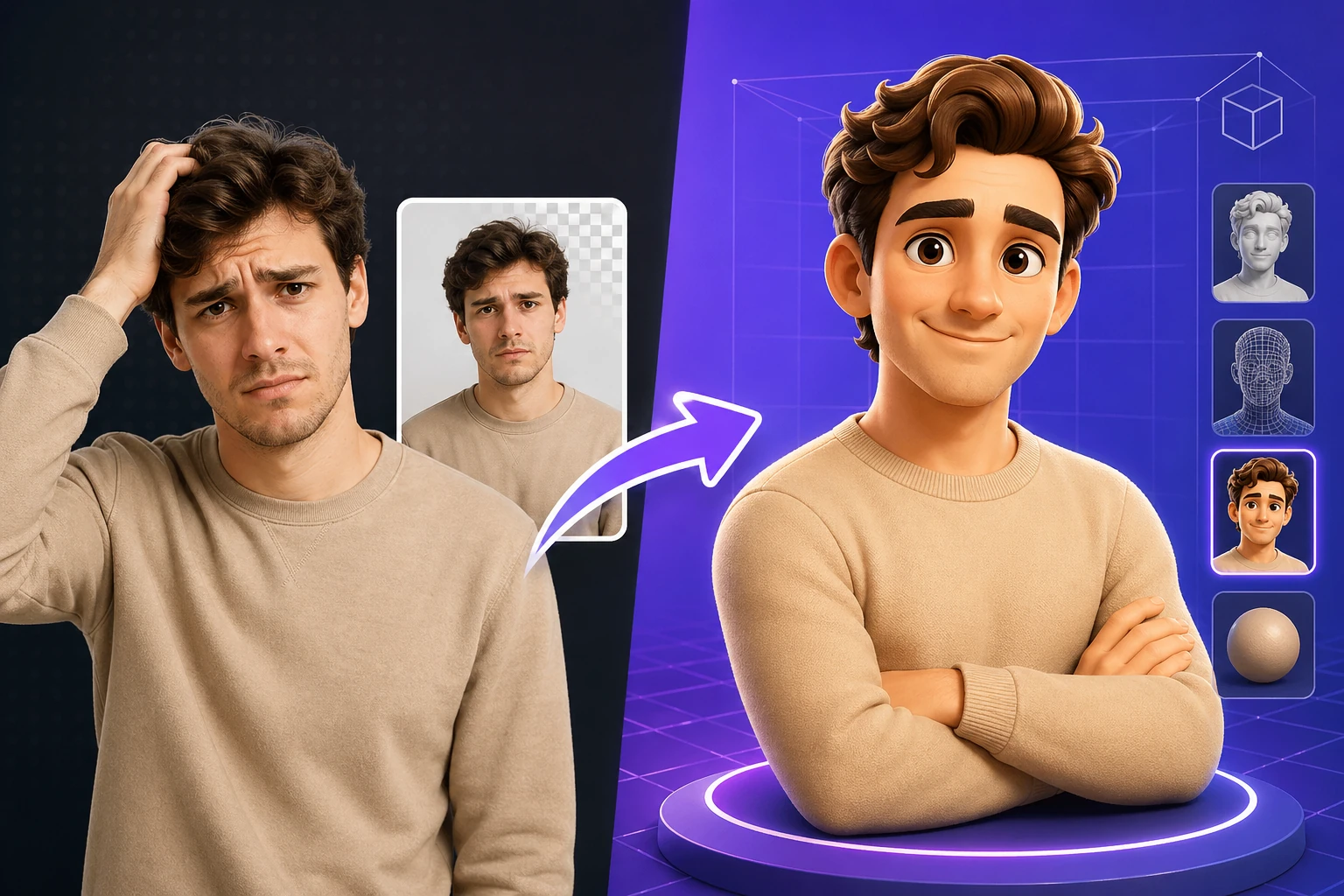
A product designer needed a rough 3D concept model of a new ergonomic keyboard for a client pitch. Traditional 3D modeling in Blender: 4–8 hours minimum. AI 3D generation from a text description + reference photo: 12 minutes for a usable mesh. The mesh was not print-ready (50,000 triangles with no UV unwrap), but it was sufficient to render a believable pitch image and get client sign-off on the form factor before committing to a full model.
That use case — concept visualization before committing to professional 3D work — is where AI 3D generation is genuinely useful today. Production-ready 3D assets for games, manufacturing, or AR/VR require human artists; AI 3D generation provides a starting point and a concept tool, not a final deliverable.
How Text-to-3D Works (Two Main Approaches)
| Approach | Method | Output quality | Generation time |
|---|---|---|---|
| Score Distillation (SDS) | Optimizes a NeRF using a 2D diffusion model as a critic — 360° views must all match the text prompt | Smooth but "blob-like" shapes; fine surface detail lost | 5–20 minutes |
| Multi-view image + reconstruction | Generates 6–12 views of the object from different angles, then runs photogrammetry-style reconstruction | Better surface detail; depends heavily on view consistency | 30–120 seconds |
| Retrieval + deformation | Finds closest 3D asset in training set, deforms to match prompt | Highest quality but limited to training set shapes | 5–10 seconds |
Output Format Guide
| Format | Use case | Compatible with |
|---|---|---|
| OBJ + MTL | General 3D editing | Blender, Maya, 3ds Max, Cinema 4D |
| GLB/glTF | Web 3D, AR/VR preview | Three.js, Babylon.js, Unity, Unreal |
| STL | 3D printing | Any slicer (Cura, PrusaSlicer) |
| FBX | Game engine import | Unity, Unreal (with textures) |
What AI 3D Cannot Do Yet
- Produce print-ready manifold meshes without post-processing — expect holes, inverted normals, and disconnected surfaces that need repair in Blender or Meshmixer.
- Generate rigged (animated) 3D characters — bones and skinning are not part of current text-to-3D pipelines.
- Maintain specific dimensions — AI models produce shapes, not engineering drawings with tolerances.